Boston Dynamics gets an AI CEO, XPeng raises $900M+, and model prices fall again
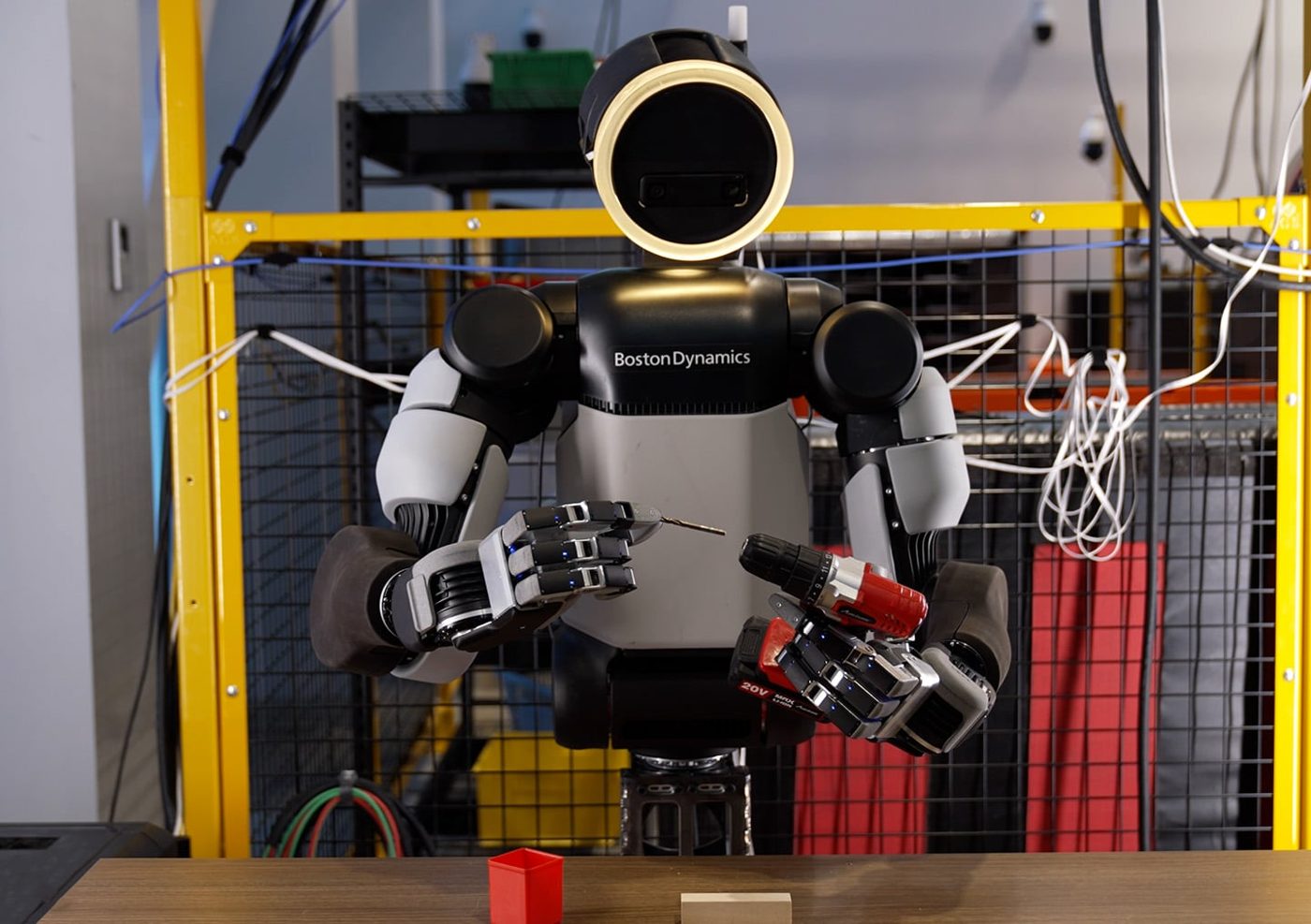
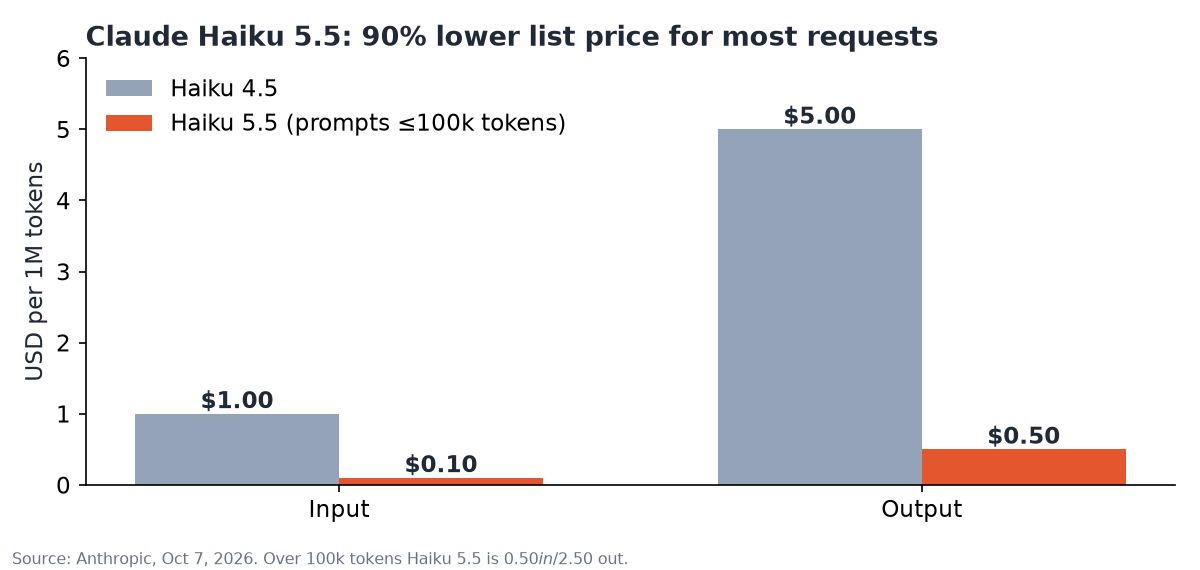
Boston Dynamics named Rohit Prasad CEO (Oct 6). He was Amazon's head scientist for Alexa and AGI. The week before, the company unveiled a new 13-DOF Atlas hand built for reinforcement learning in simulation. Also on Oct 6, XPeng's robotics unit raised more than $900M at a valuation above $6.3B. Western and Chinese humanoid leaders are now putting AI leadership and factory scale ahead of demos. Robot "brains" also got cheaper: Anthropic's Claude Haiku 5.5 lists at about 90% below Haiku 4.5 for most requests, and OpenAI made GPT-6 available to every ChatGPT tier.
The week at a glance
- Boston Dynamics: ex-Amazon AGI chief Rohit Prasad is the new CEO, and Atlas gets a 4-finger, 13-DOF hand. Robot Report · BD
- XPeng: the robotics business raised >$900M at a >$6.3B post-money valuation, and IRON mass production is targeted for end of 2026. Evertiq
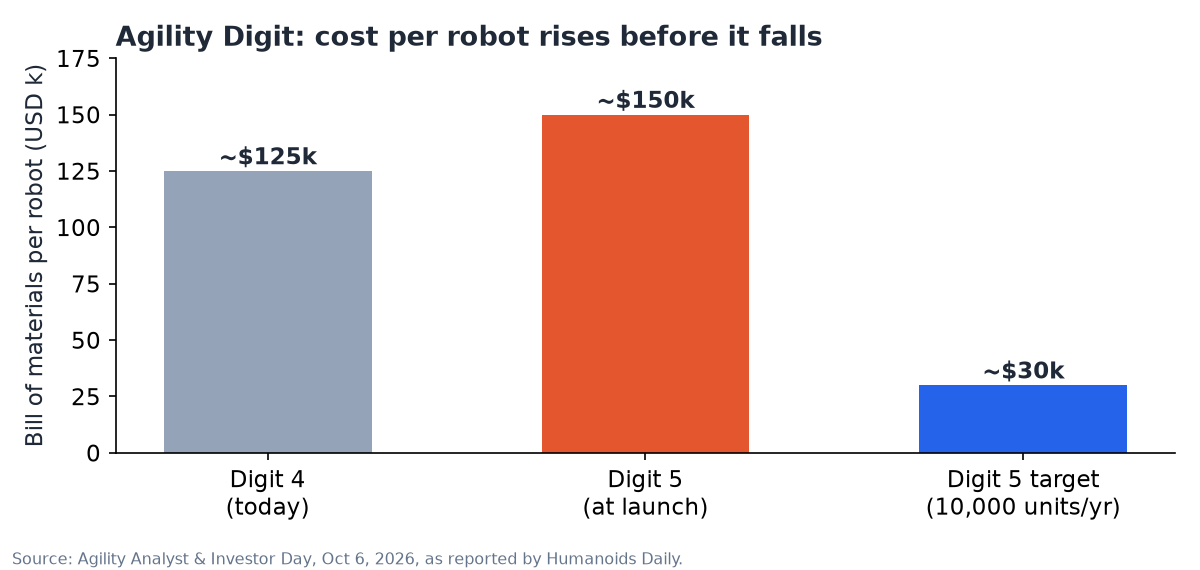
- Agility: Digit 5 parts cost ~$150k at launch, with a $30k target at 10k units a year. General availability slips to end-2027 or early 2028. Humanoids Daily
- Cheaper frontier AI: Claude Haiku 5.5 costs $0.10/$0.50 per 1M input/output tokens, and GPT-6 now reaches all ChatGPT tiers. Anthropic · OpenAI
- Robot data is becoming a business: Mecka AI raised a $60M Series B led by Sequoia, with Nvidia, M12, Qualcomm and Samsung participating. TechCrunch
1. Humanoids: leadership, hands, and unit economics
Boston Dynamics hires an AI-first CEO and redesigns the Atlas hand
- Rohit Prasad is CEO effective Oct 7 and is the company's third CEO ever. At Amazon he built Alexa and led the Amazon Nova foundation models. He takes over from interim CEO and CFO Amanda McMaster, who had run the company since Robert Playter left in February. (The Robot Report, Oct 6)
- New Atlas hand (Oct 1): it has 13 DOF, up from 7, and four fingers with no pinky. The thumb has 4 DOF, the actuators are backdrivable and directly drive the joints, and tactile sensors cover the fingertips and palm. It is designed for triggered tools such as drills, nail guns and welding torches and can still carry a 100 lb+ loaded mini-fridge. (Boston Dynamics; Robot Report)
- The new hand follows the Sept 21 opening of the Robotics Metaplant Application Center in Georgia, where Atlas trains for Hyundai factory work. That opening falls outside this issue's window and is included only as context.
Agility opens its books: Digit 5 costs, the $300M order, and a later launch
- At its Analyst & Investor Day on Oct 6, held ahead of its $2.5B SPAC merger with Churchill Capital Corp XI (expected ticker AGLT), Agility put Digit 5's bill of materials at ~$150k at launch. Digit 4 costs about $125k. The target is $30k per robot at 10,000 units/year.
- Robots-as-a-service (RaaS) economics: each robot brings in about $500k over an assumed 5-year life, for a product margin of about 50% at launch. Agility says that rises to about 70% at 1,000 units/year.
- The $300M, 1,000-robot order is released in tranches. Each use case Digit 5 proves unlocks the next batch.
- Timeline: early-access units ship in the first half of 2027, and general availability is now end of 2027 or early 2028. The S-4 filing had said late 2026.
- Safety is the gating item. Schaeffler said it still fences off every humanoid until robots are certified to safety standards. On Oct 1, Agility expanded its partnership with FORT Robotics to build an "Offboard Safety Bridge" that connects Digit 5 to facility safety systems. (Humanoids Daily; PR Newswire, Oct 1)
XPeng's robotics unit raises >$900M
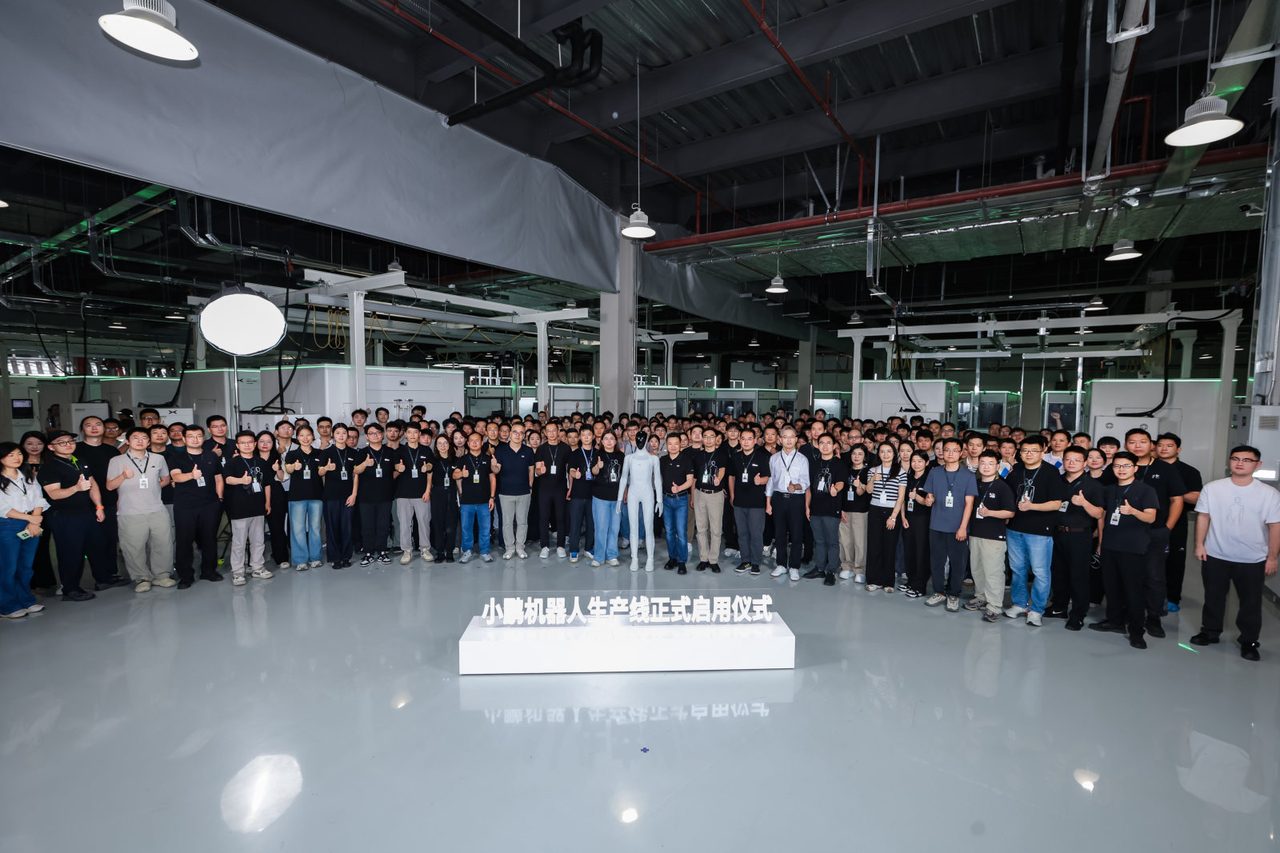
- The round was led by IDG Capital, with Gaorong Ventures participating and Tencent and Alibaba as strategic investors. The post-money valuation is above $6.3B.
- XPeng targets mass production of the IRON humanoid by end of 2026, with first deployments in its own stores and campuses. Deliveries in China and overseas are planned for 2027. (Evertiq, Oct 6)
Other humanoid news
- Nvidia–Figure (reported, unconfirmed): The Information reports that Nvidia has discussed investing another $1B in Figure at about a $38B pre-money valuation. Neither company has confirmed. (eWeek, Oct 8)
- Minerva Humanoids came out of stealth with ~$10M in pre-seed funding led by General Catalyst, with Hugging Face among the investors. Its semi-autonomous "Roger" humanoid is built for oil and gas, high-voltage and bomb-disposal work, and paid pilots start this fall. (GlobeNewswire, Oct 6)
- Donut Robotics (Japan) secured ¥300M (~$2.07M) from Charm Care to deploy its "cinnamon 1" biped across Charm Care's 100+ nursing homes. (DealStreetAsia, Oct 6)
- Persona AI, a Houston-based industrial humanoid maker, received an undisclosed investment from the Daiwa House Group Growth Fund. (Dealroom, Oct 2)
2. Funding: capital is flowing to robot data and specialized robots
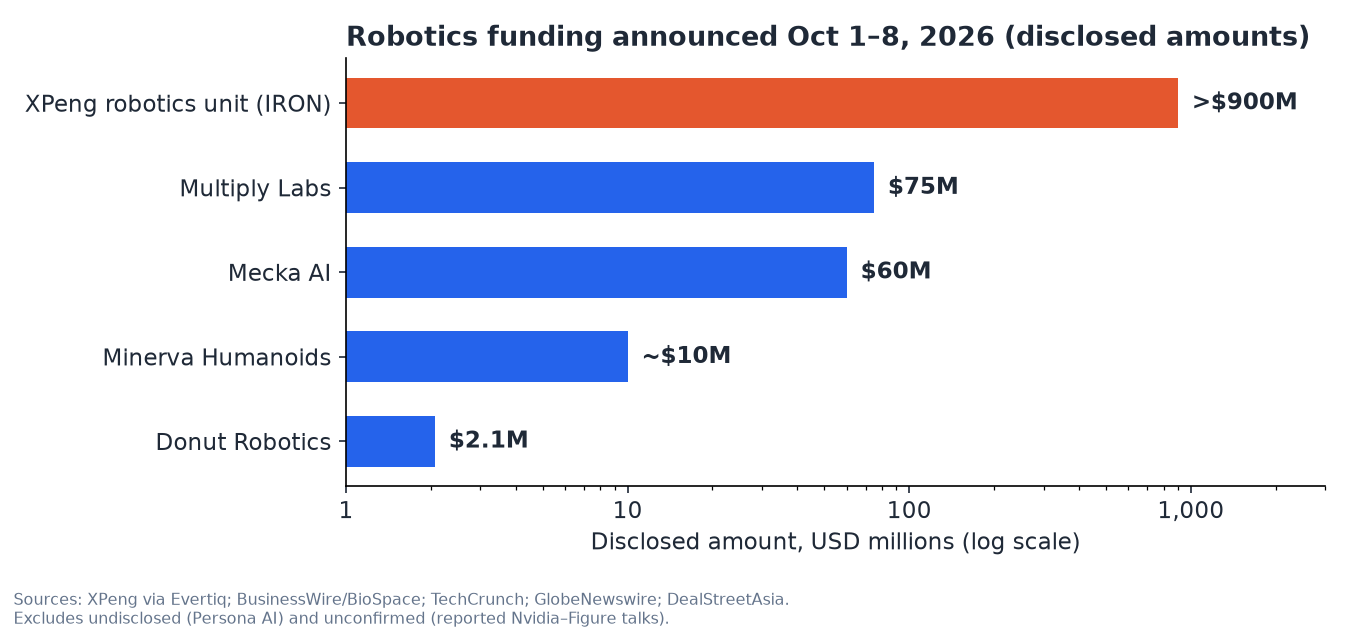
- Mecka AI raised a $60M Series B led by Sequoia, with Nvidia, M12, Qualcomm Ventures and Samsung participating. Mecka pays people to record everyday tasks while wearing body sensors and sells that motion data to robotics labs. The company says it passed $100M in annualized revenue in June 2026 and projects $300M by year-end. (TechCrunch, Oct 7; Mecka)
- Multiply Labs raised a $75M Series B for robotic biologics manufacturing. Dr. Patrick Soon-Shiong's NantWorks led, with AstraZeneca and Teradyne among the investors. (BusinessWire via BioSpace, Oct 7)
3. Models & tools: cheaper, faster, more multimodal
- OpenAI: GPT-6 for every ChatGPT tier (Oct 7). Plus, Pro, Business and Enterprise users get GPT-6 Sol starting Oct 7. Free and Go users get GPT-6 Luna starting Oct 8. Work and Codex models are unchanged. (OpenAI)
- Anthropic: Claude Haiku 5.5 (Oct 7). It scores 72.4% on OSWorld 2.1 (offline subset), against 15.7% for Haiku 4.5. It is the first Haiku with an adjustable effort setting. Anthropic also halved Sonnet 5.5 cache-read prices and added computer-use and browser-use support (beta) to its Python and TypeScript SDKs. (Anthropic)
- Mistral Large 4 public preview (Oct 6). It has 1T parameters, 52B of them active, and was trained on 3,800 Grace Blackwell GPUs in Mistral's own European datacenters. Open weights are promised by the end of October. (Mistral)
- Google: EmbeddingGemma 2 (Oct 6) is a 740M-parameter, Apache-2.0 on-device embedding model that maps text, code, images, audio and video into one embedding space. Google Cloud also launched the Gemini agent (Oct 8), a single work agent that plans tasks and connects to business systems. (Google; Google Cloud)
- JetBrains Mellum2.1 (Oct 8) is an open coding-agent model: a 12B mixture-of-experts with 2.5B active parameters, licensed Apache 2.0. (JetBrains)
4. Research & open source: world-action models are the trend
- UniWAM: Unified World-Action Model (arXiv, Oct 1). An 8B mixture-of-transformers model that combines a physical reasoner, a world generator and an action predictor. It is trained on visual question answering, human egocentric video and robot data, and the code is open. (arXiv; GitHub)
- UniWAM is one of several world-action-model papers trending on Hugging Face Daily Papers this week. Others include Long-WAM, PointWAM, RealtimeWAM and "World Action Modeling with Progressive Visual Planning". Models that jointly predict future frames and robot actions are becoming the default research direction for robot policies. (HF Papers, week 41)
- InterMimicGen (UIUC and NVIDIA, arXiv, Oct 5). It pools 16,059 human–object motion clips (140.68 hours), retargets them to six robot setups (Unitree G1 variants, Booster T1/K1, Dexmate Vega), and runs a self-improving loop. Over five rounds the set of verified, executable motions grows more than 100×, and the motions transfer to real robots. (arXiv)
- RobotWorld (arXiv, Oct 7) is an 84-task simulation benchmark for general-purpose AI agents operating robots across manipulation, locomotion, driving and aerial control. Today's agents build sophisticated perception and control pipelines, but those steps still don't add up to reliable task completion. (arXiv)
Note: citation counts can't be measured for papers this new. These picks are based on community attention (HF Daily Papers) and how relevant they are to humanoid development.
5. What to watch next week
- Mistral Large 4 open weights, due by end of October. It would be the largest European open-weight model.
- Whether the Nvidia–Figure investment is confirmed, and at what valuation.
- Agility's SPAC close (AGLT, expected this quarter) and progress on humanoid safety certification. Agility's materials list ISO 25785-1 as approved.
- RoboBusiness 2026, Oct 20–21 in Santa Clara.
Method: items were checked against primary or dated sources and limited to announcements made Oct 1–8, 2026. Context items from outside that window are labeled. Charts use only disclosed figures from the linked sources. Company claims (revenue, benchmarks) are attributed to the company and have not been independently verified.