Physical Intelligence opens a robot-model API, Agility sets its listing vote, and big open-weight models ship
Physical Intelligence opened a beta API (Oct 13) that lets any robot team fine-tune and run its π models without building its own training stack. The same day, the SEC declared Agility's merger filing effective, which sets a Nov 2 shareholder vote on a Nasdaq listing expected to raise more than $620M. Two days later Agility named Nyobolt to supply a Digit 5 battery that recharges in 9 minutes. Austin's ICON raised a $200M Series D to build its Titan construction robots. Fifteen Leju humanoids are now doing routine work on a Chinese car-parts line, and Korea cleared 20 humanoids to work beside people. Open-weight AI got bigger: Meta released Muse Spark Open (816B parameters) and Reflection shipped Beam's weights under Apache 2.0.
The week at a glance
- Physical Intelligence: the Pi API beta lets teams upload robot data, fine-tune π models on PI's compute and run them through hosted inference. No price has been published. 1
- Agility: listing vote on Nov 2, more than $620M in expected gross proceeds, ticker AGLT. Digit 5 is planned to work 90 minutes per 9-minute charge. 6
- Humanoids at work: 15 Leju robots load parts at a Hangzhou plant with a reported 98% success rate, and Korea lets 20 Robros humanoids work beside people in four industries. 8
- ICON: a $200M Series D co-led by Baillie Gifford and BlackRock funds will pay for Titan production and a new R&D facility in Austin. 13
- Open weights: Meta's Muse Spark Open (816B total, 42B active), Reflection's Beam (Apache 2.0) and NVIDIA's Nemotron 3.5 Super VL (120B). 1920
- Hiring: Agility posted five supply-chain roles on Oct 15. Across the six companies we track, 57 roles opened and 58 closed.
Companies in this issue
- USPhysical Intelligence
- USAgility Robotics
- CNLeju Robotics
- USNVIDIA
- USUltra
- TWFoxconn (Hon Hai)
- USBoston Dynamics
- USTesla (Optimus)
- KRRainbow Robotics
- CNAstribot (Stardust Intelligence)
- USApptronik
- USAmazon Robotics
- CNXPeng Robotics
- USFigure AI
- ESTHEKER
- ILEnigma
- ITGenerative Bionics
- SGSharpa
- USDyna Robotics
- USGeneralist AI
- USWalden Robotics
1. Robot AI as a service: Physical Intelligence opens its models
Physical Intelligence opens its robot models through an API
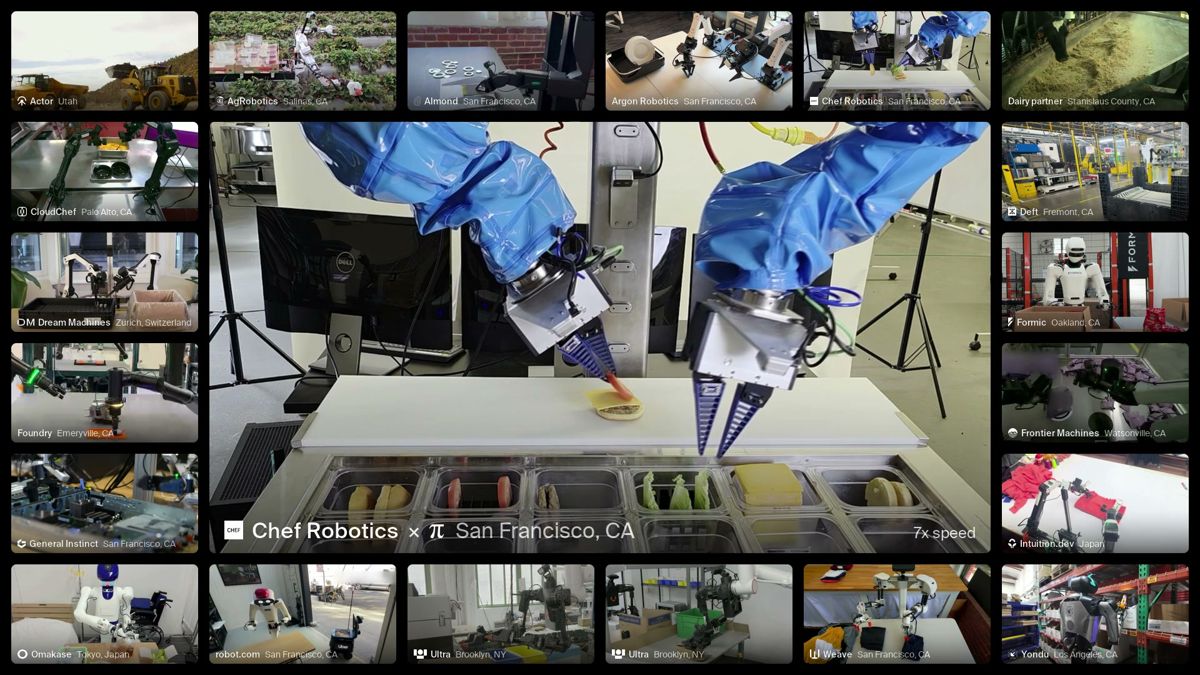
- What launched (Oct 13): a beta API for Physical Intelligence's latest robot foundation models. Teams upload demonstrations, launch fine-tuning on compute PI manages, and run the tuned model on their own robots through a hosted inference gateway. PI says the newest model in the API needs less data to fine-tune than earlier versions. 1
- Early users: a small group of companies had early access. Almond got its Axol dual-arm robot deburring parts after four days of iterating through the API, and Actor runs a wheel loader that fills dump trucks in a commercial deployment. Most showcased applications used cloud inference, and PI says network connectivity was a problem for some of them. 2
- Access and price: PI is onboarding teams in batches by application. The form asks about the robot setup, the team's training experience and how many hours of teleoperated data they have. No pricing has been published. PI's open-source models (π0, π0-FAST and π0.5) remain available for teams that want to run everything themselves. 3
Frontier chat models are being tested as robot controllers
- A SenseNova research report (Oct 15) tested OpenAI's GPT-6-Astra on 12 robot benchmarks covering tabletop arms, humanoids, mobile robots and dexterous hands. With demonstrations supplied as in-context examples and more steps allowed, the authors call its results "unprecedented." 4
- On 8 real robot setups, they found substantial gaps. The demonstrations it needs are expensive to collect, and taking more time to raise the success rate is not practical on physical hardware. The setup that worked pairs GPT-6-Astra as a high-level planner with a low-level controller such as π0.5, which the authors call costly but effective. The code is open. 5
2. Humanoids: Agility's listing vote and robots on real production lines
Agility sets a Nov 2 vote and picks a nine-minute battery for Digit 5
- The listing: the SEC declared the merger registration with Churchill Capital Corp XI effective on Oct 13, and shareholders vote on Nov 2. Expected gross proceeds are more than $620M: about $424M from the SPAC trust, if no shareholders redeem, plus about $200M from a share sale led by Foxconn. Agility expects to close in November and trade on Nasdaq as AGLT. 6
- The numbers it is selling: more than $300M in committed Digit 5 orders, which depend on contract milestones. Digit is committed at nine customer facilities, and Agility targets up to 25 by the end of 2027. Earlier Digits have logged 65,000+ hours of work, and its RoboFab factory in Salem is designed to build up to 10,000 robots a year.
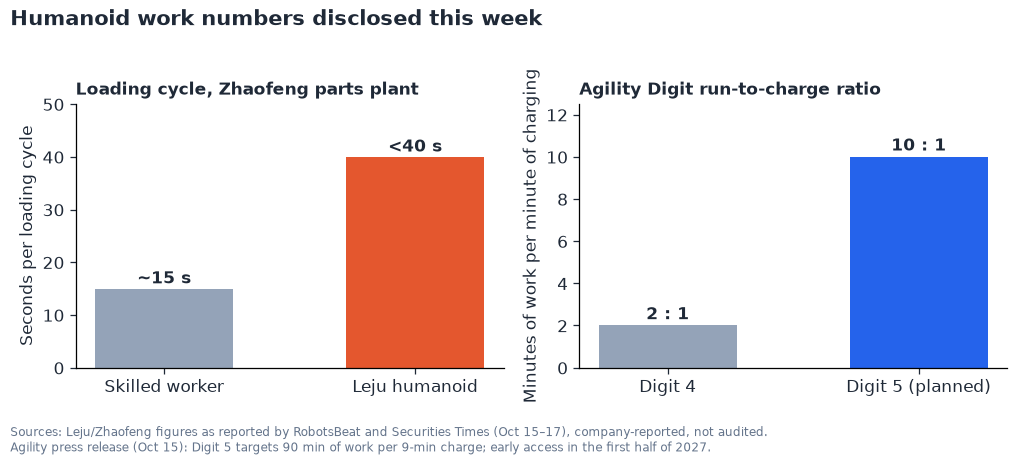
- The battery (Oct 15): Nyobolt will supply a fast-charging pack for Digit 5. Agility plans 90 minutes of work per 9-minute charge, a 10:1 ratio compared with Digit 4's 2:1, for more than 20 hours of work a day. Agility's own risk language calls Nyobolt the exclusive battery provider. Early access starts in the first half of 2027. 7
Humanoids at work: 15 on a Chinese parts line, 20 cleared in Korea
- Leju and Zhaofeng (Oct 15): 15 Leju humanoids are in routine operation at Zhaofeng's No. 3 factory in Xiaoshan, Hangzhou. They cover 15 loading stations and more than 10 types of part, including wheel-hub bearings, with a reported 98% loading success rate. Each cycle takes under 40 seconds, compared with roughly 15 seconds for a skilled worker. Zhaofeng says the project has run for more than two months, about 1,000 operating hours, and has helped produce over 60,000 parts. These are company figures, not audited. 8
- Korea (Oct 13): a regulatory sandbox committee under the trade and industry ministry granted Robros an exemption to deploy 20 bipedal humanoids in spaces shared with workers. They will clean semiconductor packaging parts at Nepes, place car-body parts at Sungwoo Hitech, stack ship scaffolding at HD Hyundai Samho and move refrigerated packaging at Delivery Lab. The old rules treated robots as fixed machines that needed safety fences. The exemption requires risk assessments and safety measures. 9
Also this week
- Boston Dynamics says it now takes about a day to build an Atlas and aims for about an hour next year, according to a senior technical program manager in a new video about its prototype shop. That is a build time, not a production rate. 10
- Tesla and positioning without GPS: Elon Musk replied on X (Oct 16) that "SpaceX Starlink enables precise navigation without the need for GPS satellites." Tesla, not SpaceX, has a published US patent application on locating cars by Starlink satellites (US20260309876A1). Navigation that doesn't depend on GPS matters for drones, defense autonomy and outdoor robots, where GPS can be jammed or blocked. 11
- Samsung Medical Center described (Oct 16) a humanoid surgical-assistant robot it is building with Rainbow Robotics and others under Korea's ARPA-H program. The robot hands over instruments and operates an endoscope in a simulated operating room, and it still needs clinical trials and approval as a medical device. 12
3. Funding: ICON raises $200M in Austin, and strategics buy in
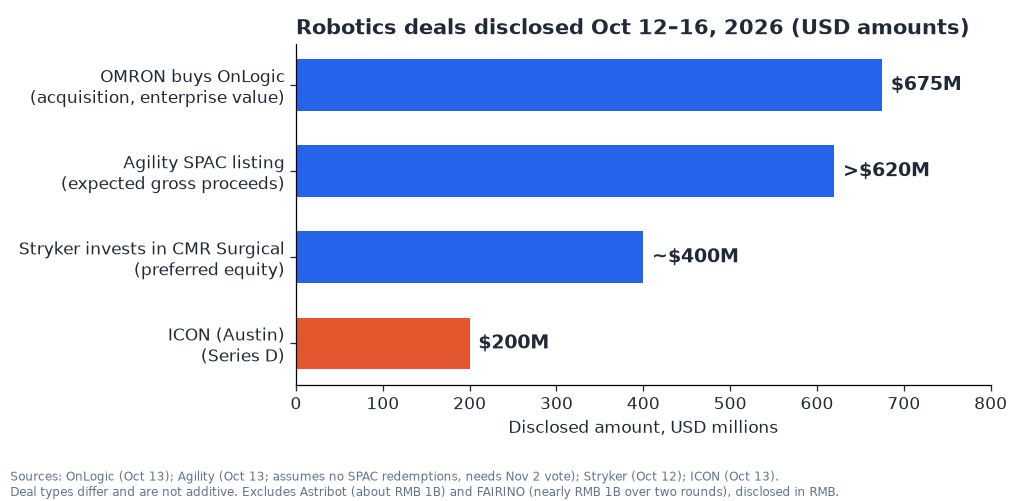
- ICON (Austin, robotic construction) raised a $200M Series D co-led by Baillie Gifford and funds managed by BlackRock. Capital Factory, Norwest, Tiger Global and others also took part. The money starts production of Titan, ICON's multi-story printing system, at its Austin factory and opens a large R&D facility in Austin. ICON says it is on pace for 4x revenue growth in 2026, without giving revenue, and has built more than 270 structures. Its defense and space unit has won more than $370M in government contracts. 13
- Stryker will invest about $400M (£300M) in preferred shares of CMR Surgical and become the exclusive US sales agent for its Versius surgical robots. The deal includes an exclusive option to buy all of CMR later, and it still needs regulatory approval. 14
- OMRON agreed to buy industrial-PC maker OnLogic and its parent, Interlogic, for $675M in cash. That is about 4.4 times Interlogic's 2025 net sales of $154.2M. OMRON wants to pair the computers with its sensing, robotics and control products for physical AI, and expects to close around January 2027. 15
- Astribot (Shenzhen, cable-driven humanoids) raised about RMB 1B at a reported RMB 15B valuation, its fourth round since March. Toposcend Capital, part of Shenzhen Investment Holdings, led the round. Astribot's cheaper T1 robot started shipping in June at about RMB 90,000. 16
- FAIRINO, a Chinese maker of collaborative robot arms, disclosed nearly RMB 1B across a Series C+ and a Series D, both led by Meituan or its investment arm. 17
4. Models & tools: open weights get bigger, and Google ships Gemini 4 Argon
- Google: Gemini 4 Argon (Oct 13) is generally available through the API and AI Studio at an introductory price of $2 per million input tokens and $10 per million output tokens. Google says it ranks first on the Vals Index of finance, coding, legal and tax work. 18
- Meta: Muse Spark Open (Oct 15). Weights for a natively multimodal model with 816B total and 42B active parameters and a 1M-token context, built for coding and agents. Meta says it runs on two Apple M5 Ultra Mac Studios. The license is the Muse Model License with limited commercial terms, not a standard open-source license. 19
- Reflection: Beam weights (Oct 16). As promised in Issue #2, the 501B-parameter model (23B active) is now on Hugging Face under Apache 2.0, in BF16, FP8 and NVFP4 formats. It comes with a drafter model for faster decoding, more than 40 launch partners and an open-source terminal agent called Mirror. 20
- NVIDIA: Nemotron 3.5 (Oct 15). Super VL is an open 120B model that reads text, images, documents and video, released with open datasets and training recipes. Bolt 74B-A9B fits in 24GB through native 2-bit quantization. Bolt E4B (4GB) is aimed at voice and physical agents on Jetson and arrives Oct 23. 21
5. Research & open source: sharper robot vision, shared world models and an open humanoid
- GroundingPI (XPeng AI) was the most-upvoted robotics paper on Hugging Face Daily Papers this week, though it first appeared on arXiv on Sept 30. The 4B-parameter model outputs points and boxes for "which object, where," even in clutter. It averages 73.68% across 34 grounding benchmarks, ahead of GPT-6 Astra's 71.54%. Used as a robot's vision backbone, it beat the strongest alternative by up to 24.8% (relative) in unfamiliar settings on RoboTwin 2.0. Code is open. 2223
- GreenWAM (Sber Robotics Center, Oct 13) trains one world model across 20 robot families, from two-armed setups to dexterous humanoids, by mapping them onto shared joint coordinates. On a real humanoid it succeeded more often than policies adapted from π0.5 and Cosmos 3 Edge. Code is open. 2425
- Reflex (University of Washington) teaches a humanoid to catch thrown boxes using only its own depth camera. In simulation it reached 85.7% catch success, close to the 87.9% it scores when given the box's exact position. Removing visual history cut success by more than 35 points. 2627
- LeWAM learns a world model and a policy together. Compared with earlier models of this type, it raises success on contact-rich tasks from 28.6% to 89.7% and plans 32.3 times faster. 28
- RoboParty RP1 (Oct 15) is a full-stack open-source humanoid from Shanghai. It stands about 1.3 m tall with 24 actuated joints, or 30 in the Pro version, not counting the hands. RoboParty has released its body design, documentation for its own joint actuators, low-level drivers, control code, simulation and training tools. Its earlier open humanoid project has more than 2,600 GitHub stars. 2930
Note: citation counts can't be measured for papers this new. These picks are based on community attention (Hugging Face Daily Papers upvotes) and how relevant they are to humanoid development.
6. Hiring and the map: Agility builds out its supply chain
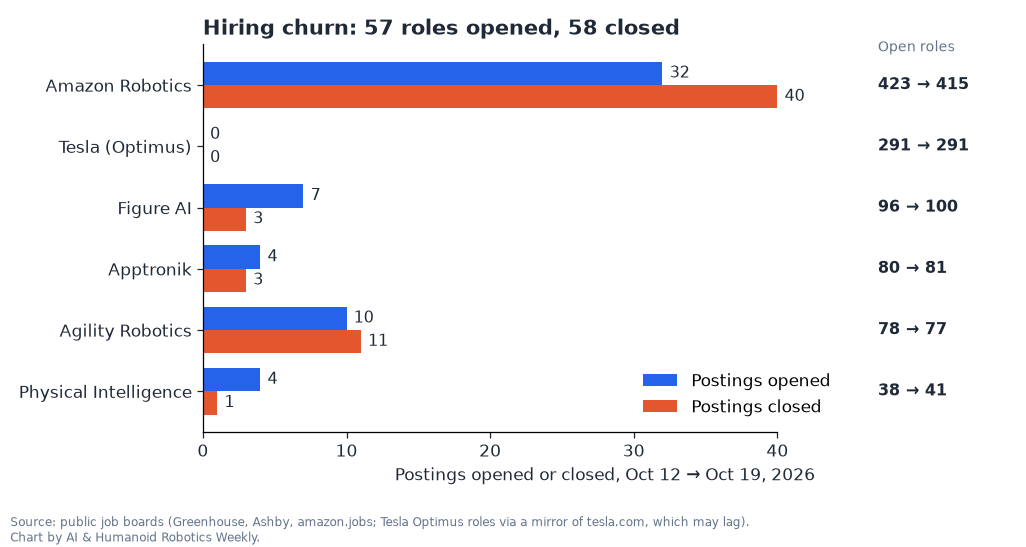
- Busy underneath, flat on top. Open roles at the six companies we track went from 1,006 to 1,005, but 57 postings opened and 58 closed. This is the first full seven-day comparison, and none of the hiring trends we track changed.
- Agility posted five supply-chain roles on Oct 15. Two are global supply managers for circuit boards and cable harnesses in Fremont, and three are a supply planner and two buyers in Salem. Supply-chain openings went from 2 to 6. Together with open quality and test roles in Salem, this may mean Agility is lining up suppliers for higher-volume Digit builds (medium confidence). It closed 11 roles and is at 77 openings.
- Apptronik (80 → 81) closed three senior engineering-lead postings in Austin, including the senior manager of mechanical engineering and the production-engineering lead. They may have been filled ahead of Apollo builds (low confidence). It added a perception learning engineer in Sunnyvale.
- Figure (96 → 100) added field and data roles, including a mobile service technician and a materials planning manager for human data collection (low confidence). Physical Intelligence (38 → 41) added four operations roles, including a general manager of research operations and a hardware recruiter.
- Amazon Robotics fell from 423 to 415, with 32 roles opened and 40 closed. Fauna-titled postings dropped from 45 to 39. It lists Austin on 91 roles, up from 89. Tesla Optimus is flat at 291 for the fourth week, which likely reflects a lagging mirror of its job board, and it lists Austin on 43.
- The map grew from 82 to 90 companies since Issue #2. New profiles: THEKER (Barcelona), Enigma (Israel), Generative Bionics (Genoa), Sharpa (Singapore), Dyna Robotics, Generalist AI, Ultra and Walden Robotics. Hiring sections now appear on 28 company profiles. 31
7. Rumor mill: a frontier lab's $1B robot-data program
- Unconfirmed: an unnamed frontier AI lab is running a robot-data buying program of more than $1B, according to channel checks by the research firm Funda AI. At market rates of $150–200 per processed hour, that would be roughly 5–6.7 million hours of data, and delivery is expected to take more than a year. 32
- Funda also reports that robot post-training uses about 3–4 times the GPUs of text-only post-training for a model of the same size, and that NVIDIA, Tesla and others are buying first-person (egocentric) video of people.
8. What to watch next week
- Tesla's Q3 results on Oct 21 after the market closes, the next chance for official Optimus figures. Also RoboBusiness 2026, Oct 20–21 in Santa Clara.
- Agility's Nov 2 vote and its redemption level, which decides how much of the $620M arrives.
- NVIDIA Nemotron 3.5 Bolt E4B for Jetson on Oct 23, and Mistral Large 4 open weights, which Hugging Face lists for Oct 31. 33
- Pricing for Physical Intelligence's API, and whether it offers on-robot inference.
Method: items were checked against primary or dated sources and limited to announcements from Oct 12–19, 2026 that Issue #2 did not cover. Context items from outside that window are labeled. Charts use only disclosed figures from the linked sources. Company claims (revenue growth, orders, success rates, benchmarks) are attributed to the company and have not been independently verified. Hiring counts come from public job boards. The rumor-mill item is unconfirmed.
Sources
- Physical Intelligence, Oct 13 ↩
- Humanoids Daily, Oct 13 ↩
- Physical Intelligence, API application ↩
- Hugging Face Papers ↩
- GitHub ↩
- Agility, Oct 13 ↩
- Agility, Oct 15 ↩
- RobotsBeat, Oct 17 ↩
- Seoul Economic Daily, Oct 14 ↩
- Humanoids Daily, Oct 14 ↩
- Elon Musk on X, Oct 16 ↩
- Samsung Medical Center, Oct 16 ↩
- ICON, Oct 13 ↩
- Stryker, Oct 12 ↩
- TNGlobal, Oct 14 ↩
- EqualOcean, Oct 14 ↩
- TechNode, Oct 19 ↩
- Google, Oct 13 ↩
- Meta, Oct 15 ↩
- Reflection, Oct 16 ↩
- NVIDIA, Oct 15 ↩
- Hugging Face Papers ↩
- GitHub ↩
- Hugging Face Papers ↩
- GitHub ↩
- Hugging Face Papers ↩
- GitHub ↩
- Hugging Face Papers ↩
- RoboParty via PR Newswire, Oct 15 ↩
- GitHub ↩
- Robotics map ↩
- Funda AI, Oct 12, paywalled; free preview only ↩
- Hugging Face ↩