Tesla starts building Optimus, NVIDIA teams up with Agile Robots on a reference humanoid, and robot-AI startups raise $350M
Humanoids took real steps toward factories this week, but nearly every date that matters, from Tesla's outside deliveries to OpenAI's demo, now lands in 2027.
The week at a glance
- Tesla: Optimus production has started in Fremont. Reaching the line's rate of about 20,000 a week will take at least a year, and outside deliveries are now targeted for late 2027. 12
- NVIDIA and Agile Robots: the Agile ONE SN reference humanoid (31 DOF, Jetson Thor) arrives in early 2027. Isaac Lab 3.0 is out, plus a new runtime, Isaac OS. 12
- Agility: an AGCO pilot in Hesston, Kansas, from 2027, four new customers it doesn't name, a 50,000 sq ft Pittsburgh site, and IGX Thor as Digit 5's only onboard computer. 4
- Funding: Eka ($150M), Dream Labs ($90M), Formic ($50M), Enact ($30M) and Maxinsights ($30M). 18
- AI labs: OpenAI confirmed it is building a humanoid, and Google DeepMind had Gemini 4 Argon teach Apptronik's Apollo cornhole from one human video. 16
- Markets and policy: Noetix filed confidentially for a Hong Kong IPO, and IDC forecasts humanoid sales in the US in 2030 will be 58% (over $6B) below what they would otherwise be, because the FCC now blocks new foreign-made models, mostly Chinese, from being sold in America. 24
Companies in this issue
- USTesla (Optimus)
- USNVIDIA
- DEAgile Robots
- USAgility Robotics
- USEka Robotics
- USDream Labs
- GBGoogle DeepMind (Gemini Robotics)
- USApptronik
- CNXPeng Robotics
- DENEURA Robotics
- ITGenerative Bionics
- CNUnitree Robotics
- CHABB Robotics
- DEKUKA
- CHHexagon Robotics
- DESereact
- DKUniversal Robots (Teradyne Robotics)
- GBDexory
- FRPollen Robotics (Hugging Face)
- USOpenAI (Robotics)
- USBoston Dynamics
- USPhysical Intelligence
- US1X Technologies
- USAmazon Robotics
- USFigure AI
- USMecka AI
- USOrigin
- CNOla Dimensions
- CNKinetix AI
- VNVinMotion
- VNVinDynamics
1. Humanoids: Optimus enters production, Agility signs a farm-equipment maker
Tesla starts Optimus production and pushes customer deliveries to late 2027
- What Tesla filed (Oct 21): "Optimus production began in Fremont on our high-volume lines. The bots coming off this line are the first production-quality bots that we have manufactured." Tesla says the current process is "suitable for a commercial product." 1
- The timeline from the call: most of a line designed for about 1 million robots a year (about 20,000 a week) is installed in the former Model S/X space. Musk said reaching that rate will take at least a year because parts of the design are still changing. Deliveries to outside customers should start around the end of 2027, beginning with industrial work. Tesla plans to build 10,000–20,000 robots to practice tasks in an "Optimus Academy," put its AI5 chip in Optimus around April 2027, and release a video of unscripted tasks "within a month or two." 2
- What still needs work: Musk said the hand is the biggest remaining problem. During Tesla's investor call, custom gears were also singled out as a challenge and Musk also listed the AI, the electromechanical design and durability as unfinished.
- The cost: GAAP net income was $0.8B, down about 43% from a year earlier, on roughly flat revenue of $28.0B, as spending on AI, Optimus and chips rose. 13
Why it matters: Tesla now has a production line but no outside customers for another year, and Agility (2027 general availability) and XPeng (deliveries in the first half of 2027) are on similar schedules. Musk's plan to train 10,000–20,000 robots in-house shows that data, not the factory, is the constraint. If you supply hands, actuators or gears, Tesla says its design is still changing, so suppliers can still get in.
Agility adds AGCO, a bigger Pittsburgh site and NVIDIA compute for Digit 5
- AGCO (Oct 20): the Fendt and Massey Ferguson maker signed a commercial agreement to pilot Digit at its Hesston, Kansas plant starting in 2027. Digit will sort and stack parts and place totes into storage. 4
- Pittsburgh (Oct 21): a 50,000 sq ft facility supports what Agility calls four new customers in automotive, consumer goods and agriculture. It hasn't named them. In the merger filing that carried the release, Agility repeats that its $300M in orders is "subject to satisfaction of certain contractual milestones." 56
- Compute (Oct 22): Digit 5 will use NVIDIA IGX Thor modules, which makes NVIDIA its exclusive onboard compute provider, and will build more of NVIDIA's Halos safety stack into its system for detecting people. Early access is still planned for the first half of 2027. 7
- CEO interview: on CNBC (Oct 20), Peggy Johnson said Agility is "agnostic" on language models and "swap[s] them in and out," and builds its physical AI in-house. 6
Why it matters: Agility's shareholder vote on going public is Nov 2. It's merging with Churchill Capital, a blank-check company. Within two weeks it has picked a single supplier for its batteries (Nyobolt) and another for its onboard computers (NVIDIA). That settles key parts of Digit's design before mass production.
NEURA opens a robot gym in Munich and launches 4NE1 Gen 4
- NEURA and the Technical University of Munich opened the TUM RoboGym (Oct 22), more than 2,300 m² where companies from over ten industries train robots on their own tasks. The partners are investing about €17M over three years, about €11M of it from NEURA. NEURA plans more Gyms in Europe, the US and China, and is building another with RWTH Aachen. 8
- 4NE1 Gen 4 is 20% lighter than the previous model, has a textile skin, and is "being prepared for series production." It runs Neuron AI, NEURA's model that takes in touch, force and sound as well as vision.
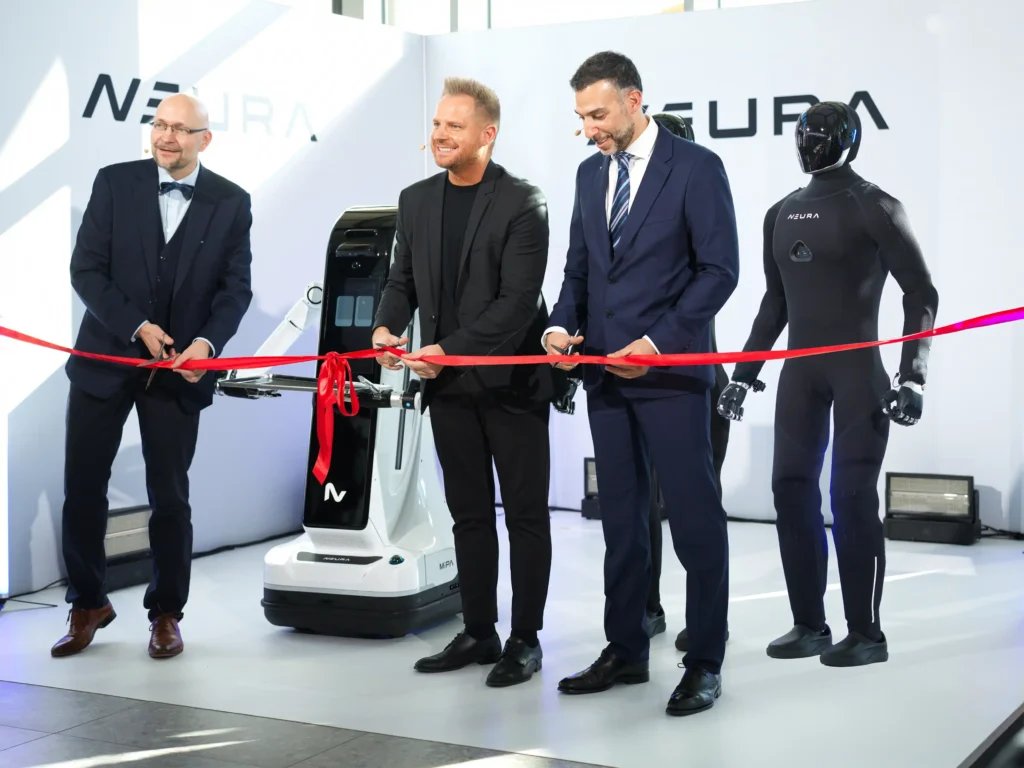
Why it matters: "Robot gyms" are becoming Europe's answer to US data farms: customers bring their tasks, and the vendor keeps the data. NEURA, Generative Bionics (below) and NVIDIA's partners are all building data infrastructure in Europe this month.
Also this week
- Unitree released the H2-X (Oct 21), a 1.8 m humanoid built on its H2 platform for guarding and rescue demos, which Unitree says runs about 8 hours. Founder Wang Xingxing told Bloomberg he now expects a robotics breakthrough as soon as 2028. 910
- Generative Bionics (Genoa) plans a network of three "Physical AI Data Factories" on AMD hardware, starting with a 5,000 m² hub in Italy. 11
2. NVIDIA at GTC Berlin: a reference humanoid with Agile Robots and Isaac Lab 3.0
NVIDIA teams up with Agile Robots on a reference humanoid and opens its robot stack
- Agile ONE SN (Oct 21): a ready-built research humanoid from Munich's Agile Robots, preloaded with Isaac GR00T and running on Jetson Thor. It is 1.40 m tall and weighs 40 kg, with 31 degrees of freedom, two 20-DOF WUJI hands with tactile sensing, and a planned Halos safety integration. Availability is early 2027, and NVIDIA names Stanford and ETH Zurich as interested. Press reports put Agile's 2027 target at 1,000–2,000 units. 1213
- Open tools: Isaac Lab 3.0 (open source, generally available), Isaac OS (an open runtime built on Holoscan), more than 2,000 simulation-ready assets in SimReady Central on Hugging Face, and a Human 1M dataset of human activity with 3D hand tracking. The full Human 1M dataset is open only to Cosmos Coalition partners. Three reference workflows on DGX Station pair GR00T 1.7 and Cosmos with OpenAI's ChatGPT Astra.
- Who's building on it: ABB, KUKA, NEURA, Humanoid, Hexagon, Sereact, Flexion and Universal Robots. Agility, Dexory, FORT Robotics and KION are integrating Halos. Hugging Face and Pollen built Microduck, an open-source robot that costs $399, on Isaac Lab, and reports say pre-orders passed 20,000 after Jensen Huang showed it on stage. 14
- Capital: NVIDIA also named Agile Robots among four German startups it plans to invest in, without giving amounts. 15
Why it matters: By backing a reference humanoid built with Agile Robots, NVIDIA is setting the default research platform, the way its DGX boxes did for AI labs. If your robot uses a different computer, expect labs and customers to ask how it compares with GR00T on Thor. For startups, the open Isaac Lab 3.0 and SimReady assets cut simulation setup costs. The Human 1M dataset rewards joining NVIDIA's coalition.
3. AI labs: OpenAI commits to a humanoid, and DeepMind teaches Apollo from video
- OpenAI (Oct 18–19): Sam Altman said on the Sources podcast that OpenAI is building a humanoid ("the world is very much designed for people"), and told Fortune: "I think we'll have a cool demo in 2027." He said the design matters less than "the brain that makes the robot work," and that robots won't be walking the streets "for a few years." Reports count about 27 open OpenAI robotics roles, including manufacturing and supply chain. 16
- Google DeepMind: given one ordinary video of a person playing cornhole, Gemini 4 Argon wrote its own MuJoCo simulation, tuned it against data from the real robot and trained the throw for Apptronik's Apollo, which then landed seven shots in a row. On a tabletop task, the same method raised a robot arm's success rate from 56% to 75%. Google reports 87% on its own ERQA embodied-reasoning benchmark, which nobody else has reproduced. The demo was shown the week of Oct 12 and reported on Oct 22–23. 17
- Price change: Argon's introductory API price ($2/$10 per million input/output tokens) doubles on Dec 1.
Why it matters: Every frontier lab now has a robotics plan. OpenAI is building its own robot, Google supplies brains to partners such as Apptronik and Boston Dynamics, and NVIDIA sells the stack. DeepMind's demo matters most for cost: if a general model can turn a video into a simulation, the expensive step of building simulations and collecting demonstrations gets cheaper. OpenAI building its own robot also means robot makers that partnered with it are now competing with it.
4. Funding: $350M for robot brains and robot data
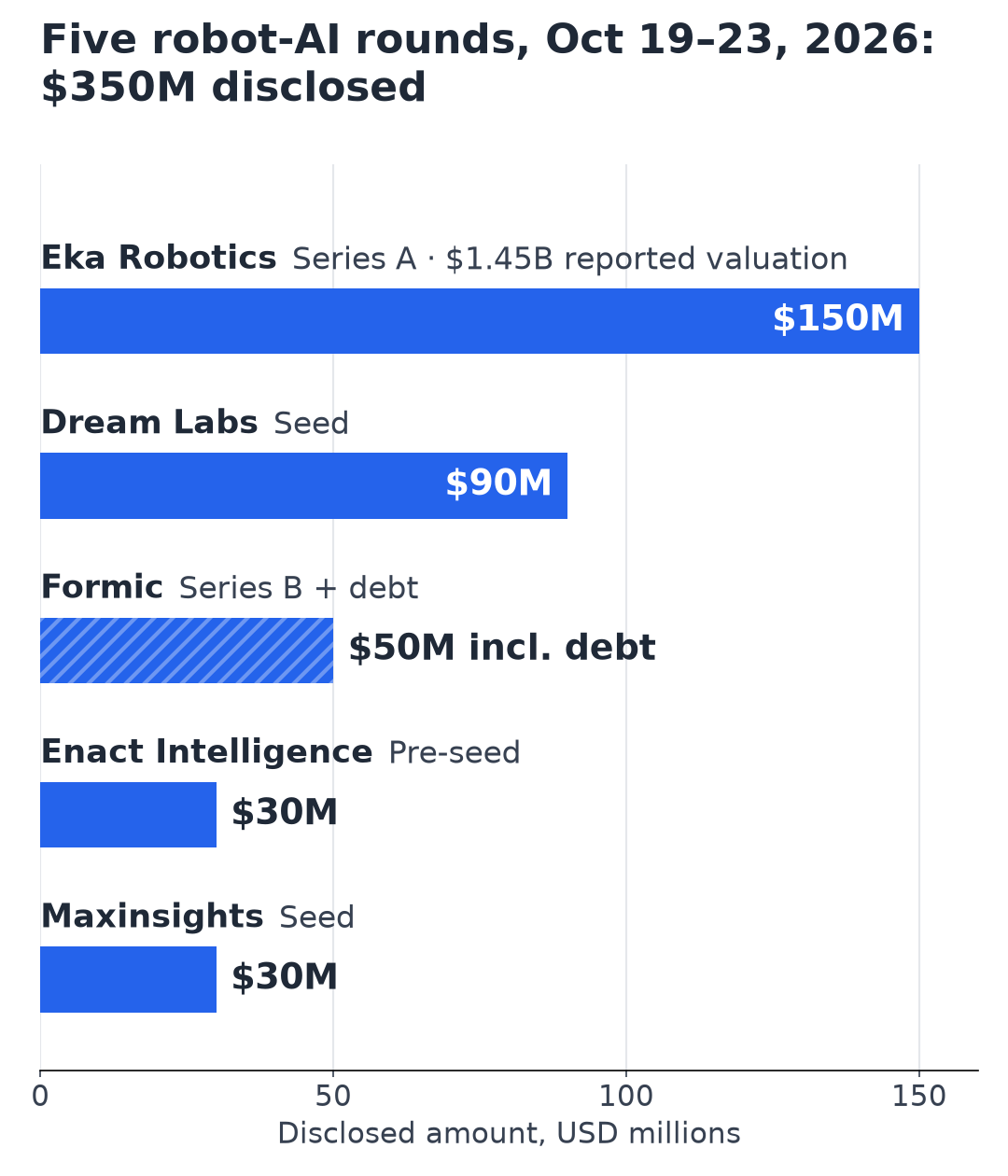
- Eka Robotics (Cambridge, MA) raised a $150M Series A led by a16z and F-Prime at a reported $1.45B post-money valuation. Its "Vision-Force-Action" model is trained by reinforcement learning in simulation and uses a gripper with extra force sensors. Eka claims 1,500 picks an hour of unfamiliar objects, against about 600 for a person. Its co-founders are MIT's Pulkit Agrawal and Tuomas Haarnoja, a co-creator of the Soft Actor-Critic algorithm. 18
- Dream Labs (San Francisco, founded by former NVIDIA GR00T researchers) raised a $90M seed led by B Capital and Kindred, and opened an API for Dream-1. The model predicts gripper poses rather than joint commands, so it can drive robots it hasn't seen. It is priced at $3 per robot-hour, or $2 for Dream-1-flash. Zero-shot support covers two-armed robots with parallel grippers, and it is a research beta. 1920
- Formic (Chicago, robots for a monthly fee) raised $50M: a Series B led by Mercato Partners plus debt from S2G. Formic says it runs robots in more than 100 facilities with 99.6% uptime, and it is adapting Physical Intelligence models using its own production data. 21
- Enact Intelligence (Zurich) came out of stealth with a $30M pre-seed, one of Europe's largest, from redalpine, Notion and firstminute, with angels Yann LeCun and Mistral's Arthur Mensch. Founder Manuel Galliker led software for 1X's NEO and later worked at Physical Intelligence. Enact reads force from its own actuators instead of fingertip sensors. 22
- Maxinsights raised a $30M seed led by Peak XV to pay more than 5,000 people to film real work for robot training. 23
Why it matters: A month after Physical Intelligence opened its API, Dream Labs published a per-hour price for a robot model, the first public price we've seen. Investors are also paying for opposite bets: Eka and Enact say touch and force sensing beat models trained only on video, while Maxinsights and Dream Labs are betting on video. If you build robots, test both kinds of model on your own task before committing to a vendor.
5. Markets and policy: a Hong Kong IPO filing and a 58% US haircut
- Noetix Robotics (Beijing; legal name Songyan Power) has filed confidentially for a Hong Kong IPO that could raise several hundred million dollars, with a listing as early as 2027, Bloomberg reported on Oct 22, citing unnamed sources. Noetix hasn't confirmed it. Noetix sells the Bumi humanoid for about RMB 9,988 (~$1,400), and a CATL-linked fund led its March Series B. 2425
- IDC forecasts humanoid sales in the US in 2030 will be 58% (over $6B) below what they would otherwise be, because the FCC's July 28 order, which added foreign-made advanced robots to its Covered List, now blocks new foreign-made models, mostly Chinese, from being sold in America. IDC says Chinese vendors make about 95% of the world's humanoids. The FCC gave Intel a one-year waiver for its factory robots on Oct 23. 2627
Why it matters: Chinese humanoid makers are lining up public money in Hong Kong while the US market closes to their new models. For US startups the FCC rule is a shield, but it also cuts off cheap Chinese research platforms and parts. Intel's waiver shows that exemptions will be decided case by case, so if your operations depend on Chinese hardware, document why now.
6. Hiring and the map: Amazon's Fauna staffs up in New York
- Amazon's Fauna unit opened a wave of New York roles that spans the whole robot: actuators and gearboxes, embedded software, motor control, perception, human-robot interaction, simulation and industrial design. A full-stack push centered on actuation and people-facing interaction may mean Fauna is moving from prototype toward its next hardware revision, built in New York (medium confidence). Elsewhere at Amazon, new Nashville roles in a supplier center of excellence may point to more formal supplier management for robot parts (low confidence).
- Agility closed several senior software roles, including two Fremont staff architects for dynamic simulation and platform software and a senior AI research engineer, while its new roles are operational, such as a maintenance and repair technician in Salem. The roles may have been filled, or Agility may be narrowing its software hiring ahead of Digit 5 (low confidence).
- Physical Intelligence is hiring a new team to build and stock physical workspaces "across every shift" in San Francisco (manager, coordinator, specialist). That may mean its robot data collection now runs on multiple shifts and is big enough to need its own set crew (medium confidence). Figure's new roles are mostly for its BotQ factory, such as a manufacturing quality engineer, which fits a production ramp.
- OpenAI's open robotics roles cover manufacturing and supply chain, not just research (see AI labs). New this week are hardware roles such as an electrical engineer for circuit-board test infrastructure, alongside open motors and actuators manufacturing roles. That suggests OpenAI plans to build and test its own actuators and robot electronics (medium confidence).
- The map grew from 90 to 101 companies since Issue #3. New profiles include Eka Robotics, Dream Labs, Mecka AI, Origin, Ola Dimensions, OpenAI (Robotics), Kinetix AI and Vietnam's VinMotion and VinDynamics. 28
7. What to watch next week
- Agility's Nov 2 listing vote and its redemption level.
- Tesla's promised Optimus video of unscripted tasks ("within a month or two").
- Mistral Large 4 open weights, which Hugging Face lists for Oct 31, and CoRL 2026 in Austin, Nov 9–12.
- Whether Agility names any of its four new customers, and Dream Labs' first results outside the lab.
Sources
- Tesla Q3 2026 Update ↩
- Electrek, Oct 22 ↩
- Electrek, Oct 21 ↩
- AGCO and Agility via PR Newswire, Oct 20 ↩
- Agility via GlobeNewswire, Oct 21 ↩
- SEC Form 425 ↩
- Unite.AI, Oct 22 ↩
- NEURA Robotics, Oct 22 ↩
- Unitree on X ↩
- Bloomberg, Oct 23 ↩
- Generative Bionics via PR Newswire, Oct 21 ↩
- NVIDIA, Oct 21 ↩
- Crypto Briefing ↩
- The Brief, Oct 23 ↩
- TFN, Oct 21 ↩
- India Today, Oct 19 ↩
- Tech Times, Oct 23 ↩
- TFN, Oct 21 ↩
- Business Wire, Oct 19 ↩
- Unite.AI ↩
- TNW, Oct 23 ↩
- EU-Startups, Oct 22 ↩
- TFN, Oct 23 ↩
- Bloomberg, Oct 22 ↩
- Sohu (Chinese), Oct 23 ↩
- Forbes, Oct 22 ↩
- AI Weekly summary of Fortune ↩
- Robotics map ↩